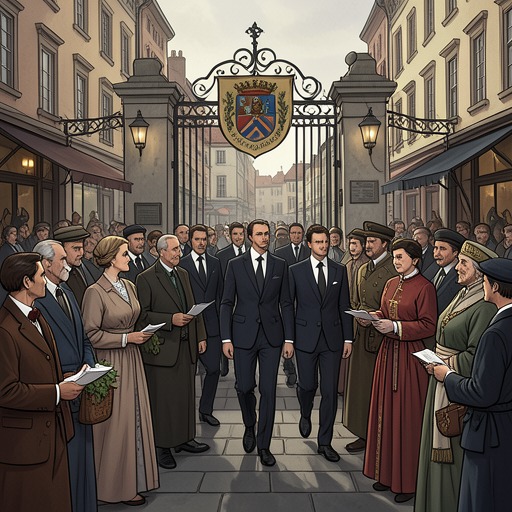
Castello Ancestral Mansion
MY POSSESSIVE BILLIONAIRECastello Ancestral Mansion is the Castello family’s ancestral home in Brazil, located near Rio de Janeiro, and the setting in which the novel’s central marriage conflict first becomes physically immediate. Its grand rooms and marbled staircase give material form to the family’s wealth, while its domestic authority turns an old business alliance into a demand placed upon Sophia Castello and Joaquin Enrique Lopez Montero III.
Setting and Family Ownership
Castello Ancestral Mansion is the home of Fredo Castello and Marcella Castello, whose daughter Sophia Castello is their only child and sole heir. Fredo’s wealth is tied to the family’s enormous pineapple plantation in Brazil, and the mansion therefore represents more than private shelter: it is the visible center of an inheritance that Sophia is expected to preserve. The house stands about an hour from Rio de Janeiro, while Beatriz, Sophia’s maternal aunt, lives alone in Petrópolis, Brazil.
The residence is presented through its grand interior, especially the marbled staircase and the living room where five-foot-tall portraits hang. One portrait depicts Sophia in a peach off-shoulder dress, with long dark wavy hair, diamond earrings, and a crucifix necklace. To Joaquin Enrique Lopez Montero III, the portrait makes her look like an innocent princess, although his judgment of her is colored by the family’s belief that she is reckless and spoiled. The portrait thus turns the mansion into a gallery of family image-making: Sophia is displayed as an heiress before she is encountered as an independent woman.
The Arranged-Marriage Confrontation
The mansion is where Joaquin Enrique Lopez Montero III arrives with his father, Joaquin Montero II, to meet Sophia. He waits nearly fifteen minutes, repeatedly looking from the marbled staircase to his Rolex watch, and grows impatient at what he considers another waste of his time. His irritation reflects the coercive structure surrounding the visit. He has agreed to obey his father because Joaquin Montero II gave his word to Fredo Castello, but he privately intends to keep mistresses, remain unfaithful, and preserve a bachelor’s life rather than submit emotionally to the marriage.
The arrangement was created through the friendship between Joaquin Montero II and Fredo Castello. When they were young, the two men defended each other, and Fredo once saved Joaquin Montero II’s life from a fire. They became protectors, confidants, and friends who regarded each other as brothers. As their wealth grew, both men came to treat the marriage of their children as a way to protect their business interests and family fortunes. The mansion is therefore the place where an older generation’s gratitude and commercial calculation are imposed on the younger generation.
Sophia rejects that authority by leaving the mansion with her luggage and going to Beatriz’s home. Beatriz is shocked to find her niece at the doorstep and warns that escaping from her fiancé is a bad idea, while Sophia insists that Joaquin Enrique Lopez Montero III is not her fiancé and that she will not marry him. Her escape converts the mansion from a promised marital home into the point of departure for her resistance to the arrangement.
Return, Surveillance, and Training
Sophia later returns to the mansion’s orbit when the family negotiates a conditional reprieve. Fredo agrees to forgive her and to stop pursuing the immediate marriage on the condition that she undergo business training so she can eventually manage the Castello family enterprise. Joaquin Montero II decides that his son is the best person to train her, making the dispute over the mansion and marriage inseparable from a professional assignment.
Before Sophia leaves Brazil for that training, Joaquin Montero II visits the Castello family and assures them that he will look after her needs. Sophia experiences this protection as another form of supervision. As an only child nearing twenty-two, she feels that her parents still treat her like a seven-year-old: her actions are monitored, her privacy is limited, and she is denied the freedom to choose the man with whom she will spend her life. The family residence consequently embodies both material security and confinement.
The arrangement also exposes the competing values of the two men who govern it. Joaquin Enrique Lopez Montero III initially refuses to offer Sophia love and wants the freedom to pursue an affair on his own terms. Joaquin Montero II warns him that a temporary affair would hurt Sophia and damage his friendship with Fredo, especially because Sophia believes in love and marriage and ran away precisely because she wanted to marry someone she loved. The mansion’s family-centered negotiations therefore place emotional responsibility against masculine entitlement and inherited obligation.
Later Reversal and Narrative Significance
The Castello family’s position eventually changes. Fredo tells Joaquin Montero II that Sophia’s happiness matters more than their original agreement and acknowledges that she has always been hesitant about the arranged marriage. Joaquin Montero II agrees that the couple cannot be forced to marry and that they are still young. Although Joaquin Enrique Lopez Montero III should feel relieved, the decision instead leaves him saddened, revealing that the arrangement has evolved from a burden into an attachment he has not yet admitted.
The mansion’s meaning culminates in the wedding resolution. Sophia Castello and Joaquin Enrique Lopez Montero III are eventually married in Brazil in an extravagant ceremony attended by many rich and famous guests. Their parents are delighted because the older generation’s dream of uniting the families has finally been fulfilled, and Fredo Castello, Marcella Castello, and Joaquin Montero II organize and pay for the celebration. The wedding transforms the family home’s earlier pressure into a public alliance, although the marriage now rests on the couple’s mutual love rather than solely on the original business pact.
As a location, Castello Ancestral Mansion condenses the novel’s conflict between inheritance and freedom. Its portrait, staircase, and lavish interior establish the authority of the Castello name; Sophia’s flight breaks that authority; the later training arrangement redirects it into business competence; and the Brazilian wedding completes the movement from imposed union to chosen commitment. The mansion is consequently both a symbol of dynastic control and the first stage on which that control begins to change.